VALUES
AND PERSONAL ATTRIBUTES OF CHI LING PAI ®.
There are many noted virtues in a student of Chi Ling
Pai® martial arts. Some of these virtues are honesty,
loyalty, generosity, and sincerity. Students of Chi
Ling Pai® are also expected to be polite and humble,
and to display a tremendous amount of patience and
self-control.
An important part of Chi Ling Pai® is the traditional
Asian family structure. Master Decker frequently
talked about “The Family,” which was the Chi Ling Pai®
gung fu brotherhood. “The Family” was a very
important part of Master Decker's teaching, wherein
everyone comes together to achieve one common goal.
CHI
LING PAI ® PRINCIPLES AND CONCEPTS.
THE
CIRCLE: SMOOTH AND FLUID MOTION.
Master Decker often said, “There is no such thing as a straight line.” He believed circular motion to be optimal, and the best approach to combat.
The “center” represents an individual’s center of
mass. If you can control a person's center, you can
control their ability to fight. For example, in Tai Chi
Ch’uan push hands practice one practitioner attempts to up
root or unbalance the other by locating their center and
using that to place them into an awkward position.
The “nine centers” are contact points that may be used to
place an attacker into an unfavorable position, giving the
defender an upper hand in the combat. These “nine
centers” are explained by the triangle principle. Master
Decker broke the body down into these nine points to help
align the student's body mass, energy, and intent as one.
These nine points include:
-
The center of the foot
-
The knee
-
The tan t’ien
-
The hips
-
The shoulders
-
The third eye
-
The center of your hand
These centers are not only used to teach
students unity in motion, but also teach how to disrupt
the opponent's center to shut down and control their
movement.
Structure (body alignment) in Chi Ling Pai® is taught
using the “nine centers” and the triangular patterns they
form. The imaginary triangles formed by these centers
build upon each other, resulting in nine triangles that
combine to form a structure called “the pyramid.” This
was Master Decker's method of explaining internal body
mechanics. By aligning your centers, you align your mass
and energy as one. For example, the combination of the
two hip centers and the tan t'ien center is what Master
Decker referred to as the Magnum Rotating Center
(MRC). It is the hips and waist.
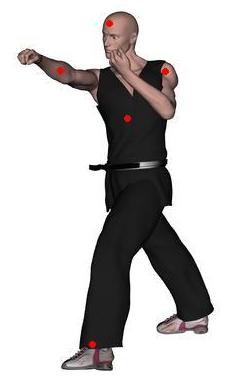
The red dots in the above image show some
important centers while an opponent throws a straight
right punch: the leading centers and shoulders, the third
eye, and lead foot. When connected, these centers form a
pyramidal structure.
The foot center is important because it is a ‘leading
center,’ allowing you to close the gap on an opponent.
Other leading center points are the front hand or arm and
shoulder. Next in importance is the third eye, followed
by the rear shoulder, which controls any follow up
strikes. The solar plexus is also a primary area of
control when working the upper body. A small blow to that
region can quickly give you the upper hand in a
confrontation.

The Pyramid.
The above image shows the alignment of the nine centers and the parallel line placement of the feet. The purpose is to align your intent, body mass, and energy as one in one direction.
DIVIDING
THE BODY BY THIRDS (SAOU CHIEN TSU).
Saou Chien Tsu, also known as “adjusting body
triangles,” is a way of specifying the nine panels (on
the upper body) to help the student to better
understand the ways of dealing with incoming attacks.
The “panels” are conceptual target locations. They
help the student get a handle on distance and space
(height, width and depth). This principle is similar
to the 'gates' principle that is found in most gung fu
systems.
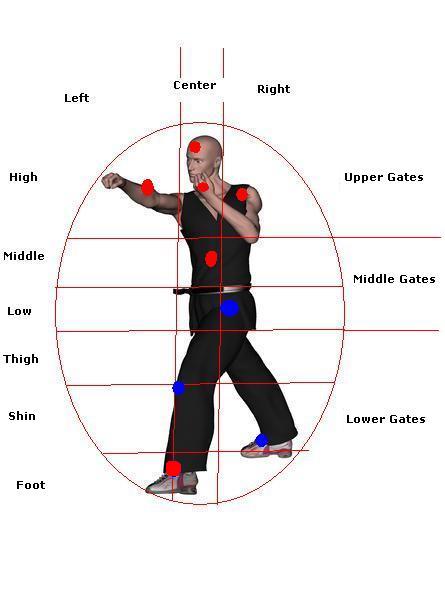
Saou Chien Tsu and
Centers within the giant 'beach ball'. The giant 'beach
ball' is the range of circular motion that surrounds the
practitioner's body, the 'sphere' that the gung fu fighter
fights within, their 'universe'. The beach ball principle
of Master Decker's is similar to the dynamic sphere theory
in Aikido.
STRONG
SIDE FORWARD.
Akin to 'putting your best foot
forward', strong side forward means adopting
the side in combat that is your handedness
(right handed or left handed). But still be
able to fight from the other side. Master
Decker was left handed and started his forms
from the left side. He also mainly
demonstrated from a left handed lead.
FEET HELD IN
PARALLEL LINES.
The feet in Chi Ling Pai ® stances hold parallel line
positions. The reason is to help guide and align our
body mass, energy, and intent as one.
SAFETY
FACTOR (18 INCHES).
The student in Chi Ling Pai ® was taught to maintain a
defensive perimeter of 18 inches from the body.
Nothing was allowed to penetrate this barrier. The
reason being that if someone gets too close it is much
harder, if not impossible, to stop their incoming
blow.
NOTE:
there are exceptions to every rule and one exception
to this principle is the Bat Sao Gung style knife
fighting that Master Decker taught that also operates
behind the 18 inches.
NINETY
DEGREES.
This was the degree of interception that was
emphasized by Master Decker when performing blocking
techniques. The point of interception between your
block and the opponent's technique he referred to as “EXP”.
FOUR
SIDED FIGHTING.
This principle meant that you could be positioned in
one of four places around the opponent: directly in
front of them, to their sides (90 degrees), and behind
them.
THE
OCTAGON.

The Octagon Principle.
The octagon represents a circular
arrangement of the nine angles of attack and defense
around the body of the opponent or the practitioner.
This is like the angles of attack in Filipino Kali.
The octagon also teaches the concept of planes. The octagon also acts as a map on the
ground to aid in understanding footwork and
positioning and it contains the Pa Gua circle.
For example, the north, south, east and west
coordinates of the octagon represent the 'four
sided fighting' positions that can be taken on
an opponent.
This is martial arts geometry. Here we
remind the reader that the Chi Ling Pai practitioner
does not move
along straight lines but rather moves in circular
motions that are described by the planes in
the octagon. Some examples of that are below.
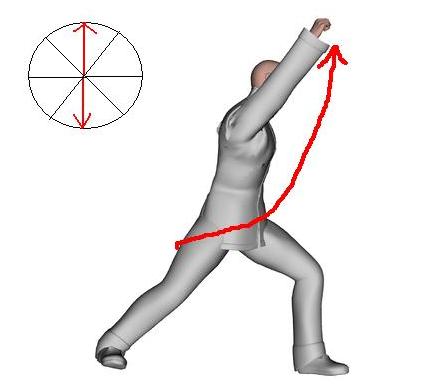
Vertical Plane Up: Rising Fist Punch. This punch is deceptive because it slips into and rises out of the opponent's blind spot position, similar to a boxer's uppercut.
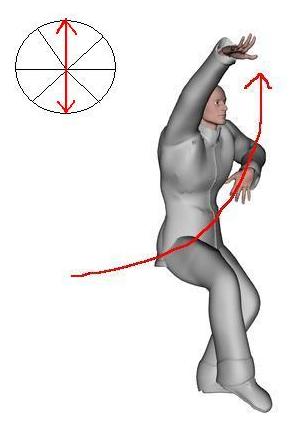
Vertical Plane Up: Crane Technique

Golden Peacock punch executed on diagnol plane down
WAYS OF HANDLING ENERGY.
There are five main ways to deal with the opponent's attacking energy in Chi Ling Pai ® and they are,
1. Accept. Accept the opponent's energy and transfer it into the ground or take it and use it.
2. Pass. Move your body (turn your waist) so the opponent steps and their energy is redirected behind you.
3. Destroy. Strike the opponent's attacking limb.
4. Cancel. Attack their body structure so their attack loses its power.
5. Neutralize.
Nullify their incoming attack so it loses its power.
This is a 50/50 approach.
- Master Decker would also use a way he called 'STOP' which could be done as either a cancel, a neutralization, or both. The stop was similar to the stop technique that is found in western boxing or the hip stop that is found in Kali-Silat.
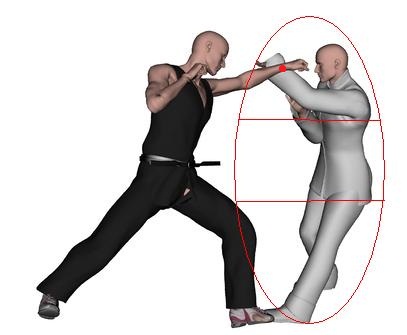
The defender who is wearing white ACCEPTs the opponent’s technique through an outside high Panel. In this case a rising crane technique (travels circularly on the vertical plane of the octagon) vs. a straight left punch. Notice the 'body language' or rotation that aids the defender in their technique (45 degrees outside angulation of the body that causes the defender's center to intersect the opponent's center by ninety degrees; EXP that is the dot that is marked in red. That is the point where the arms cross as the crane block moves through it's circular arc).
The defender ‘connects’ with the opponent and feels which helps to read the attacker's intent (their next move) as they start to control the opponent's body through slight alterations of their posture. The defender is essentially performing a kind of Tai Chi ‘push hands’ at this point to help give the defender added control over the attacker. All of the above occurs within a split second of time and without thinking.
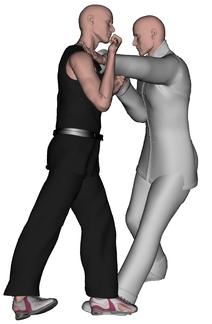
Next,
using a STOP, the defender's left hand checks the
opponent's right shoulder so they cannot throw
another punch. The opponent is effectively trapped,
or checked, on both sides and the defender can
strike by sliding up either hand.
Since either hand can threaten the opponent, this
position also uses Master Decker's “fractured
mirror” principle (or Possum, see Animal
descriptions below). This puts the opponent in a
position akin to a “pin” in chess, wherein the piece
cannot move without exposing a more valuable target.
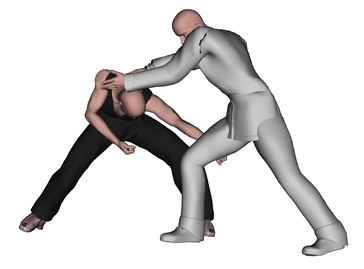
Here the defender uses a STOP against a wrestler's take down. This technique utilizes proper body alignment. WARNING: This counter is NOT meant for sport and could break the opponent's neck.
- Use the panels to help you understand height, width, and depth.
- Use the circles to help you understand the angles of attack and defense (circular motion).
- Use
the centers to align yourself and manipulate the
opponent to your advantage.
"Identify, Accept, Neutralize, Cancel, and Destroy; and above all, be patient" - Master Decker.
HORSE
TRAINING AND TRAINING THE “BASICS”.
Chi Ling Pai® uses horse training, which means the
student holds low stances for long periods of time to
strengthen their spirit, mind, and body, especially
the legs. It is a form of isometric exercise that
makes them very strong and durable. Every technique
is practiced from every stance.
This hard style training is not for the faint of heart
and tests the student's character and willpower. The
purpose was to push the student past mental barriers
and prepare them for the harsh reality of combat.
Students who are older or have limited mobility may be
trained using other methods.
STANCES
Some Chi Ling Pai® stances include
- Horse
- Bow Stance
- Cat Stance
- Fish Tail
- Spring Leg
- Leopard
HAND
STRIKES
In
addition to strikes common to most martial arts, like
the straight punch and the back fist, Chi Ling Pai®
features unique strikes, including:
- Rising fist punch: A punch that comes from under the opponent and strikes using the back of the two largest knuckles.
- Black feather: A combination of a straight punch and a reverse hook punch.
- Golden Peacock: A punch executed from above on a 45-degree downward angle.
- Iron Whip: A strike with the back of the hand executed similarly to a back fist.

The black feather punch travels forward and sideways on the horizontal plane on the octagon.

A black feather punch executed forward and sideways through the opponent's jaw.
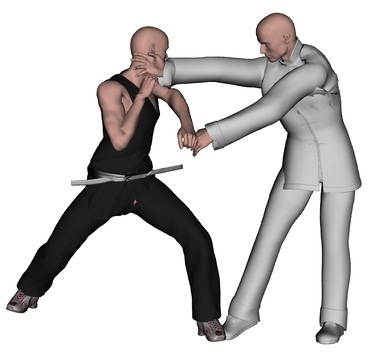
Iron Whip strike to the neck.
KICKS
Some of the kicks to be found in Chi Ling
Pai® include:
- Front kick
- Side Kick
- Hook Kick
- Monkey kick
- Spinning Double Crescent Kicks
- Lotus Kick
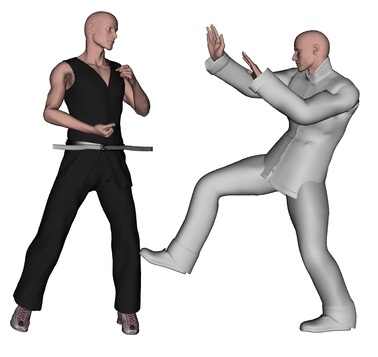
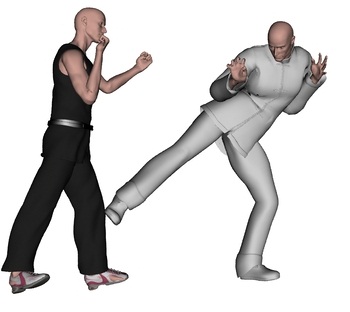
A low sidekick is used here with the outside edge of the foot to check the opponent's lead leg and close the gap. For a power strike, the heel would be used instead.
BLOCKS
Some of the blocks to be found in Chi Ling
Pai® include:
- Monkey's way block (1-2-3 block / fan block)
- Circular Tiger block
- Descending Dragon block
- The Wall
- Leopard Blocks
1-2-3
BLOCK (FAN BLOCK).
This block is taught as a drill in which one student
throws straight punches aimed at the other student's
chest. The student receiving the punches executes
three palm blocks for each punch thrown.
The drill teaches the students to feel an opponent’s
centers and intent, as well as your own center. The
fan block exercise also teaches proper technique,
stance, and what Master Decker termed “body
mechanics.”
THE
WALL.
Traditionally, this is a double forearm block that is
used to stop powerful blows such as high roundhouse
kicks. It also acts as a destruct because it can be
very Painful to the person who is striking or kicking
at you. It can also be used with one forearm.
Stopping an opponent's movement in this way uses both
the “Accept” and “Neutralize” principles taught by
Master Decker.
Both the 1-2-3 Block and The Wall are concepts, not
just techniques, and these concepts extend into other
aspects of the art in many ways. These two concepts
usually repeat themselves in much of Chi Ling Pai®.
BLOCKING
AND STRIKING USING THE SAME HAND.
A favorite tactic of Master Decker's was to block and
strike using the same hand, usually his front left
hand. This is an advanced form of blocking because it
takes less time and distance to execute a counter
strike. Master Decker also combined this approach
with simultaneous blocking and striking, implementing
attack and defense at the same time.
TAKE
DOWNS
Some Chi Ling Pai® take downs include:
- Third Eye Take-Down
- Iron Broom
- Spinning Top
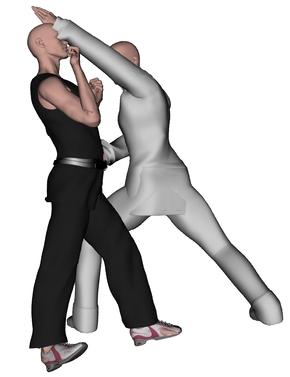
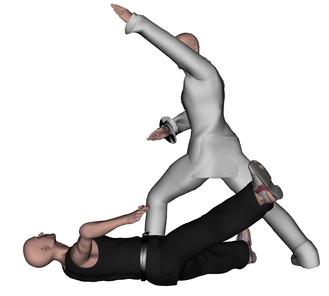
After: felled opponent.
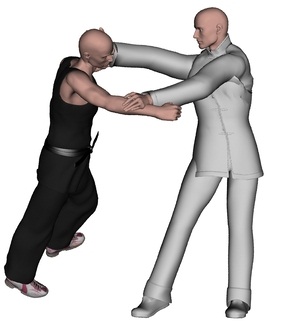
Third Eye Take down against right hook punch: a circular throw down with palm slap, utilizing the shoulder center and third eye center.
FORMS.
Forms are choreographed patterns of movement practiced
alone or in pairs. They act as a library of movement
to teach the student the techniques, principles, and
mechanics of a martial art. One of the primary
methods of learning Chi Ling Pai® is through its
forms.
THE
TIGER AND CRANE FORM.
This form is the foundation of Chi Ling Pai®. It
contains all 864 basics of the system. Many concepts
and principles are found within this form and it
typically takes a student over a year to learn, and
many more to master.
Other Chi Ling Pai® forms include Five Animals, Fists
of the Five Ancestors, Seven Setting Suns, White Lion,
King Mantis, and Butterfly. The author has counted at
least 23 forms taught by Master Decker, not including
the weapons forms, and is sure there were more.
However, you are only required to learn 15 forms. Not
everyone is taught the same forms. They are taught the
ones that match their personality and body type.
ANIMAL
FIGHTING TECHNIQUES.
Chi
Ling Pai® contains animal fighting techniques. These
are unusual movements, unexpected by the opponent, and
they focus force differently due to the different
shapes of the fists. This gives the practitioner
versatility and an advantage over ordinary fist
punching and striking.
Although the basic hand and body positions can be the
same, the fist, attitude, and expression of the Chi
Ling Pai® practitioner changes to adopt the particular
animal that is being articulated. It is also about
energy and character expression, not just the physical
tools. What follows are examples of the animal styles
in Chi Ling Pai® Gung Fu.
Bear Style is
lumbering, but strong and usually suited to a more
stocky or large-sized fighter. This style involves
powerful whipping and explosive palm striking
movements.
Snake Style is
cold-hearted and pinpoints weaknesses, using finger
strikes to vital points, palm strikes, and coiling
movements that trap the opponent's limbs.
Monkey Style,
usually suited to smaller persons, uses animated fast
body movements, pawing movements, backhanded strikes,
and trapping.
Leopard Style is
a quick and powerful in-fighting style usually best
fitting for medium-sized, athletic persons. The style
involves a flat shaped fist that strikes with the fore
knuckles and is based on speed and explosive rapid
fire striking. Using a flat fist, the force of the
leopard strike is concentrated into a smaller
horizontal area like a wedge, increasing its impact.
The leopard fist can fit more easily into places a
normal fist cannot, such as between the ribs.
Crane style is
elusive and usually suited for longer limbed
fighters. Poised, soft, yet also explosive, crane
utilizes a beak fist that strikes using dotting of the
fingers or the back of the hand. Crane also strikes
using the backs of the hands, palms, and fingers to
the eyes. It contains the wing block (elbow
rotations).
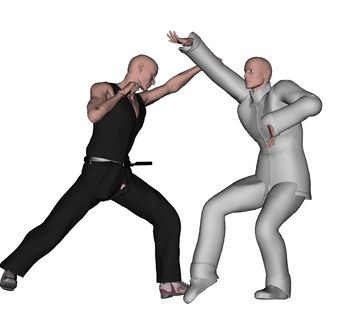
High Crane vs. Straight Left
Mantis
style is similar to crane style but
uses a fist where the index finger protrudes,
the mantis fist. It is usually suited to strong
and muscular short to medium sized fighters.
Mantis uses trapping motions with arm breaks,
eye pokes, leg sweeps and breaks, and rapid
style punching and palming.
Tiger,
usually suited to “alpha personalities,” is a
very direct, hard style that is strong and
aggressive. Dynamic tension style movements
are trained. This form emphasizes sheer
aggression using clawing motions, pounding with
tiger palms, and pinching and ripping movements.
Eagle,
another aggressive animal, uses forearm strikes,
hammer fists, wing blocks and strikes, pinches
muscles and bone (collar bone as an example),
and a three-finger claw to the throat.
The Phoenix style
contains a fist where the first index knuckle
protrudes. This one knuckle punch allows the
practitioner to focus their energy into a very
small point, which greatly increases impact.
Phoenix fist is used to destroy incoming punches
by striking the tender parts of the arm, such as
the back of the hands, forearms, biceps and
targets the vital points of the body such as
behind the ear and the neck.
The Dragon style
(a favorite of Master Decker) employs long arm
flowing circular motions consisting of hammer
fists, forearms, and fist blows. Dragon fist is
similar to Phoenix fist, with the middle knuckle
protruding instead.
“Prince Dragon” is a technique that destroys
incoming blows using a painful sideways slap of
the palm. Therefore it's nickname “prints
dragon” because it leaves a red palm print on
the opponent's forearm.

Long Arm Dragon. The arms move in circular patterns as the
defender (black) shifts in their stance from side to side.
Possum
is an advanced animal technique that was taught by
Master Decker. It involves set ups such as slipping
the palm under the arm of the opponent to bait and
switch them. The opponent takes the bait and then is
hit by a powerful blow from the other hand that is
waiting in the blind spot, and vice versa.
“Teacup” is a
special fist formed like holding a cup in your hand.
Back of the hand strikes are used to attack the
muscular regions of the opponent's body and their
arms.
The above are just some of the extraordinary
techniques and sub-arts that can be found within
Master Decker's Chi Ling Pai® Gung Fu. Different
practitioners specialize in different specialties
depending upon what matches their individual
personality, preference, and energy.
BAT
SAO GUNG.
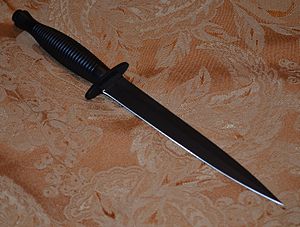
Bat Sao Gung (Eight Hand Fighting) was Master Decker’s style of knife fighting. This is an extreme art. The movements involve 'check marks', zigzags, dotting, and trapping. The practitioner does things like cut horizontally across the attackers forehead to cause blood to drip into their eyes, blinding them. The Bat Sao Gung fighter can also trap and fillet the opponent's arms, and pound on their chest to cause their heart to palpitate to spill their blood faster.
IRON
PALM / IRON HAND.
Master Decker taught a special brand of iron hand
training. Master Decker used this method to condition
the hands to deliver a powerful impactful force, yet
the hands would not become deformed from the training.
PA
GUA
(Pronounced
“Ba Gwa”. Also spelled Ba Gua or “Ba Gua
Zhang”, meaning Eight Trigram Palm).

Master Decker's “private art”, and the art he taught advanced students, was his own personal brand of Pa Gua. Pa Gua is an art where the student practices walking around the edge of a circle in various patterns while executing techniques, including figure eights and smaller circles. It also includes walking “rails”, what Master Decker termed linear stepping, similar to Hsing I.
There were 8 circles and 8 rails that were taught. All of the aforementioned techniques and movements of Chi Ling Pai ® such as the animal fighting techniques and the Bat Sao Gung were put into the Pa Gua method of circular stepping and fighting. The practitioner became a violent tornado of motion as they struck, trapped, destroyed and wrenched the opponent's body.
S.D.S.D.S.F.
(Sifu Decker's Scientific Dirty Street Fighting).
Having a military background, and therefore being fond
of acronyms, this was Master Decker's style of street
combat. S.D.S.D.S.F. basically means “Chi Ling Pai ®
for the street.” It also contained, as he termed it,
“the aggressiveness of Kempo (karate).”
CONTINUOUS LEARNING AND GROWTH.

Chi Ling Pai ® students develop their own
personal expression of the art. For example, some
students of Master Decker may concentrate on the
animals of Snake and Bear, and have a specialty in
knife fighting. Others may concentrate on Leopard and
Mantis, and have a specialty in the chain whip or the
stick. Many students of Master Decker have also cross
trained in other martial arts and attained high rank
in other martial arts systems and families, just as he
did.
Chi Ling Pai ® students also believe in perpetual
learning and improvement. We are all students of the
martial arts. No matter what rank or awards we may
achieve or are honored to receive, we continuously
strive to learn, refine, and improve ourselves as
martial artists and as human beings. We are not only
students of the arts; we are also warrior students of
life.
THE
ONE TRUE ART.
This concept means that all martial arts are
actually pointers to the one art that is the 'super
set' of all martial arts. All martial arts are seen
as a journey to the same destination albeit using
different pathways or means. The one true art
contains all the other martial arts, binds them all
together, and results in martial art unity.
Still, the student never forgets their source and
where they came from. They continue to honor the
art(s) they have studied and the teachers that have
enabled them on this journey, and the student places
them above themselves.
Also, the concept of one true martial art is not just
meant in terms of martial physics, but also in terms
of our familial association with others and the
spiritual reality of oneness. It is within this level
that the Chi Ling Pai ® student may begin to venture
into the spiritual side of the martial arts and engage
in meditation and other practices.